
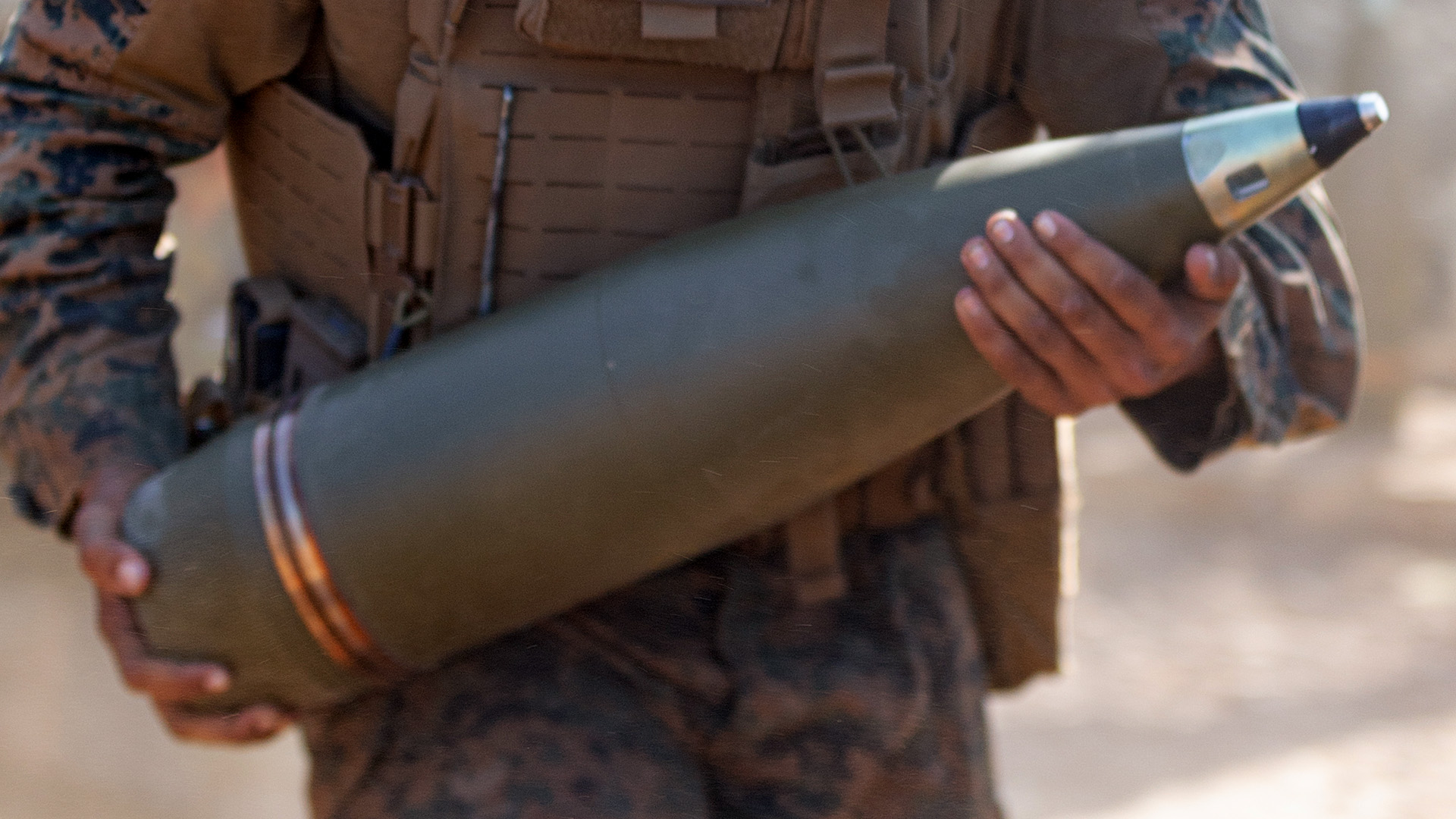
The Army spent almost half-a-billion dollars on a Texas ammunition factory to restock the military’s supply of 155 mm artillery shells, but the facility has yet to produce a single round in two years, a Pentagon watchdog found. The facility, in Mesquite, Texas, was brought online in 2024 after rounds of rapid-fire contracting to speed up the Army’s efforts to replenish artillery shells sent to Ukraine and cover increased training needs for U.S. forces.
The Texas factory was supposed to be producing 30,000 155 mm shells each month by October 2025, according to a Department of Defense Inspector General’s report. But by this March, it had yet to deliver any and the IG report said it did not expect to deliver any before September.
“The Army’s expenditure of $469 million to establish the Mesquite facility could have been used to address other Army or [Department of Defense] priorities,” the report said.
The report did not name the factory or the contractor, but the description of the facility matches a contract awarded to General Dynamics Ordnance and Tactical Systems that opened in May 2024. The report also said the unnamed contractor was the long-time operator of the Scranton Army Ammunition Plant in Pennsylvania, which General Dynamics has run since 2006.
The Mesquite factory, the IG said, tried to start a “high-risk” production line using older machines used in previous artillery production lines. Army officials in the office in charge of the contract did not return a request for comment Tuesday afternoon.
A ‘high-risk’ contract to increase artillery numbers
An Army official told Congress in February that General Dynamics’ Mesquite-based factory had yet to produce a single shell in nearly two years of operation. Brent Ingraham, the Assistant Secretary of the Army for Acquisition, Sustainment, and Technology — a position widely referred to as the Army’s “acquisitions czar” — told Congress in February the plant was not meeting goals.
“I’m not happy with where we are at Mesquite,” Ingraham said in a hearing with lawmakers, according to Breaking Defense, as he laid out essentially the same missed deadlines and poor performance the IG reported Monday.
The Mesquite factory was commissioned with a series of expedited contracts in 2022 and 2023, the IG said, to produce “projectile metal parts” for M795 High Explosive shells, which are the standard round used by U.S. Army and Marine M777 howitzers. The parts are assembled into final battle-ready rounds at Army factories in Iowa, Arkansas or Kansas. Those facilities operate faster than the parts factories, the IG said, making plants like the Mesquite factory the bottleneck in ammunition production.
The contracts were a response by the Army to quickly build-up artillery production in the wake of Russia’s 2022 invasion of Ukraine. Ukrainian forces, supplied by U.S. stocks, were firing about 8,000 M795 rounds every day, enough to eat up a year’s worth of U.S. production at 2022 levels in less than two weeks.
The Army announced plans that year to scale 155 mm shell production from about 14,000 rounds per month to over 100,000, with 30,000 coming from the new Mesquite plant. But as of March 2026, the IG said, while the Mesquite plant was offline, two other factories were producing enough parts for 46,000 rounds per month.
However, rather than build new machines for the Mesquite plant, the IG said, the Army allowed General Dynamics to convert machines used for M107 shells, an older 155 mm round that the M795 replaced. The M795 can fire about 6 kilometers farther than the M107 carrying a more powerful explosive charge.
But the decision to try the untested production program, the IG said, proved fateful. Army officials believed “the Mesquite facility was a high‑risk, high‑reward opportunity,” the IG said. The service accepted “risk associated with the contractor’s plan to purchase and adapt M107 metal part production equipment.”
But the new production lines were never able to produce acceptable M795 parts using the reworked equipment, and the Army ordered the plant to stop work completely — and stop spending money — in August 2025, an order that held through at least April 2026, the IG said.
Loading comments…
Comments couldn’t be loaded. Please refresh the page.