

I was flying one time when my copilot asked if he could do something that deviated from our unit SOP.
“Negative, Ghost Rider, the pattern is full.”
“What, sir?”
“Top Gun quote.”
“Oh, I’ve heard about that movie.”
“You’re a naval aviator and you haven’t seen Top Gun?”
I realized my copilot was only a toddler when “Top Gun” was released in 1986. Nevertheless, I failed to appreciate how far that and other movies that defined my military motivation early in life had fallen by the wayside. When I was a kid, I’d always end up seeing older movies eventually, only because there wasn’t any type of “On Demand,” and whatever WGN or TBS had on was what you watched.
Now, TV viewing is so individually tailored that one might never accidentally stumble across gems from the past. On the flip side, today’s technology also affords the opportunity to go back and enjoy the “classics” without doing a deep dive in the DVD bargain bin at Blockbuster… I mean Circuit City… I mean Walmart.
Top Stories This Week
In the 80s, people jammed the theaters to watch America kick Soviet ass. We’d just emerged from the aftermath of the Vietnam War, which produced some 1970s masterpieces, like “Apocalypse Now” and “The Deer Hunter.” Those were also complete and utter bummers. The early 1980s reversed that, with a vengeance.
In contrast, today’s theaters are jammed with a dozen gritty reboots of comic books. The mass-market comic book and action movies we get today give us CGI thrills, but the conflicts they portray are otherworldly and irrelevant. On the opposite end of the spectrum, many of the war movies we get are practically art house films, ruminating on existential questions of life. For every “American Sniper,” we get a “Blood Stripe.” They give us angst but no enjoyment.
The war movies of the ’80s appealed to the broader public, not just a niche. They addressed real issues of the day, albeit in simplified form. The nation was still turning the corner on its failure in Vietnam. In 1982’s “First Blood,” Sylvester Stallone as John Rambo deals with PTSD from his Vietnam service as he plows through a Pacific Northwest police department.
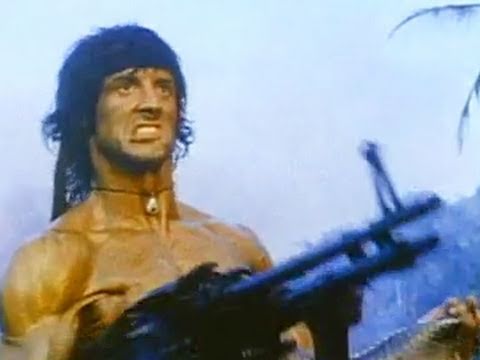
Rambo 2 (First Blood Part II) – Official Trailer
1985’s “Rambo: First Blood Part II” took him back to Vietnam to all the POWs the communists had been keeping. Their motivation made about as much sense as the movie. Apparently it’s easier to use some middle-aged illegally held Americans to pick rice than pay the exorbitant wages of Vietnamese peasants. Nevertheless, that movie gave the United States the clear victory in Vietnam that had escaped it in real life.
He finally put the commies down for the count by going into Afghanistan and fighting with the Mujaheddin in “Rambo III.” Rambo was no Clausewitz. Second-order effects were not really his thing. But these were battles were intensely relevant at the time. America kicked ass in the movies when it couldn’t kick it in real life, either because the battle was already over, as in Vietnam, or because it would never happen, as with the Soviets.
We were so in need to asses to kick and fights to win that we even made up some. The best example was 1984’s “Red Dawn.” For those of you who only witnessed the craptastic 2012 remake, it is imperative you see this amazing example of pure ’80s.
In “Red Dawn,” Russian and Cuban troops invade the continental United States, starting with a surprise airborne assault of a strategically important Colorado high school. Once one’s initial disbelief is over, “Red Dawn” is amazingly fun and compelling. A group of high school kids become the most dangerous insurgent cell in the mountain West, learning to employ Mujaheddin-like tactics against the communist invaders. In the meantime, we get to see gripping cinema such as Americans lined up for a Soviet firing squad singing “America the Beautiful” as they’re gunned down.
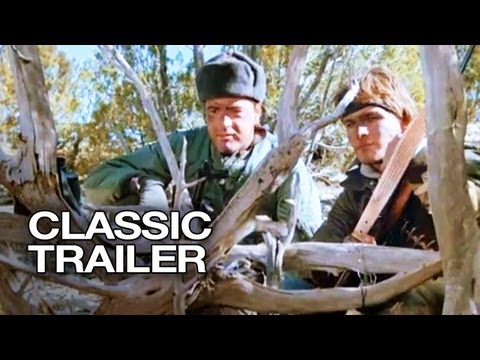
Red Dawn Official Trailer #1 – Charlie Sheen Movie (1984) HD
The culminating point of the 1980s military alternative history genre may have been “Top Gun,” released the summer of 1986. Featuring a still-hot Kelly McGillis and a Tom Cruise, who is apparently a time lord, it inspired a generation to join the Navy, which featured only slightly less shirtless beach volleyball in jeans.
The Air Force’s trailer park version, “Iron Eagle,” which featured a high schooler stealing a F-16 to rescue his father held hostage in the Middle East, was a pale shadow next to “Top Gun,” but was as much a jingoistic joy to behold as it was a technical abomination.
![Top Gun 3D - Official Trailer [HD]: Tom Cruise, Kelly McGillis and Val Kilmer thumbnail](https://i.ytimg.com/vi/B0VV8_Xr1yQ/hqdefault.jpg)
Top Gun 3D – Official Trailer [HD]: Tom Cruise, Kelly McGillis and Val Kilmer
The movies of the first half of the 80s didn’t bother with the pain of war. As the decade wound down, though, we finally started to see that pain, and not just the glory of war. The mood in the country was cooling from the “Morning in America” days of the beginning of the Reagan administration. Movies like 1986’s “Platoon,” and even more so 1987’s “Full Metal Jacket,” started to mix the bad with the good again and tell stories at least inspired by actual events. While certainly not flawless portrayals of the military, they mixed a dose of realism in with their explosions. In particular, “Full Metal Jacket” has motivated Marines to this day, even as it presents a bleak picture of military service.
![Full Metal Jacket - Trailer [1987] HD thumbnail](https://i.ytimg.com/vi/Ks_MbPPkhmA/hqdefault.jpg)
Full Metal Jacket – Trailer [1987] HD
As much as movies shape the culture, the culture shapes the movies. The first part of the 1980s gave the United States a much-needed spiritual renewal after Vietnam, and the movies both reflected and caused that. The second made the United States face war’s realities, not just its fantasy. Whether those movies caused that shift or merely reflected it is impossible to know. But they were what the nation needed and wanted as it entered the much more ambiguous era of the 1990s.
Loading comments…
Comments couldn’t be loaded. Please refresh the page.