

Before the injury, Lorna Illerbrunn said her husband would have simply wanted a retirement at a hangar, surrounded by Army helicopters, good friends, sandwiches from Jimmy John’s, and cold Miller Lite.
Lorna Illerbrunn made sure all that was there for Garrett Illerbrunn’s retirement party, but what she really wanted was to make sure he had one last time in the cockpit of a helicopter.
“It took a lot of resources, time, energy, money, but I feel like it’s something that Garrett really could see how he was being honored,” Lorna told Task & Purpose this week. “We don’t know what the future holds, and I just really wanted to make it very special for him.”
Garrett suffered a penetrating traumatic brain injury in a 2023 drone attack at Erbil Air Base, Iraq, where he was deployed as an AH-64 helicopter pilot with the 82nd Airborne Division. The size of the attack made national news at the time, including word that a pilot was medically evacuated to Germany with severe head injuries.
In the nearly two years since, Lorna said, Garrett has lived in hospitals and treatment centers. He now has limited mobility in his upper body but none in his legs and uses a wheelchair full-time. He’ll soon be medically retired as a Chief Warrant Officer 4, which prompted the party in early October.
A final flight
Earlier this month on a bright fall day, Lorna, other family members, and dozens of friends and soldiers from nearby-Fort Bragg gathered at Pinehurst Harness Track in Pinehurst, North Carolina, to watch his last flight. Lifting off in a small civilian helicopter, Garrett sat in the front left seat while Lorna rode in the back. As the pilot coaxed the helicopter forward 50 meters or so, Lorna said, her husband turned to her and said, “This is awesome.”
As a couple, the Illerbrunns’ origin story traces back to helicopters. They met while deployed to Jalalabad, Afghanistan in 2013. Lorna was a Black Hawk pilot flying medevac missions for the New Hampshire National Guard. Garrett was an active duty Apache pilot with the 10th Mountain Division based out of Fort Drum, New York. They were married in 2015 and celebrated their 10th anniversary on Thursday.
Since the military doesn’t allow married couples to serve as aircrew together, the retirement flight was their first joint helicopter ride.
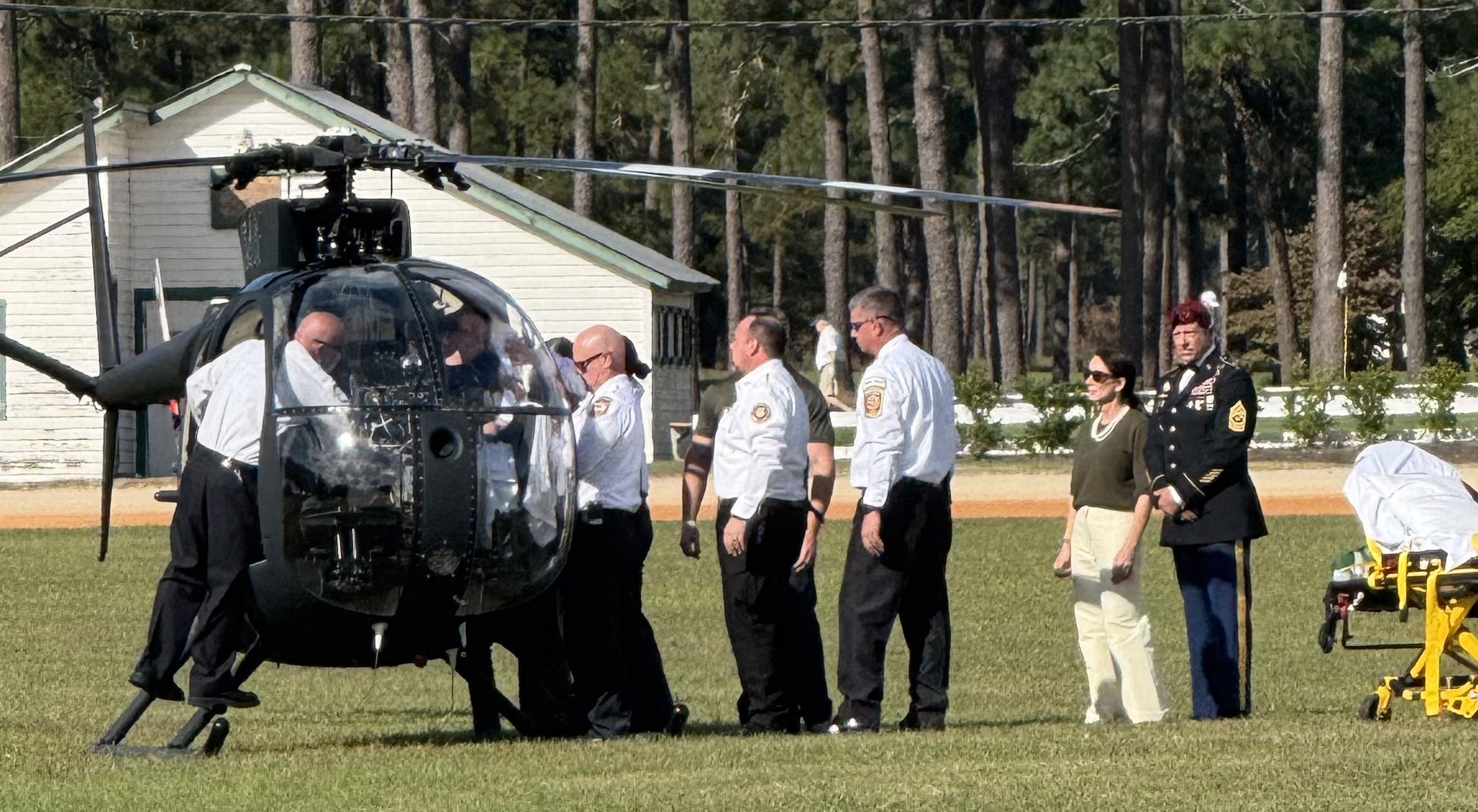
“He supported me on missions like if I was going into land for a medevac, he might be covering me in another aircraft,” she said. “But we’ve never been in the same aircraft.”
After some planning complications with the Army, Lorna chartered a civilian MD 500 helicopter, an aircraft developed from the Army’s OH-6A Cayuse and best known in military circles for its special ops version, the MH-6 Little Bird. Lorna said Garrett was particularly happy to share the day with their 9-year-old son, Tucker
“He looked over at Tucker at one point and I could tell he just felt a sense of satisfaction,” she said. “Hearing helicopters again, I think was really nice for him.”
‘There was no manual for this’
Before the 2023 attack, deployments were a routine part of married life for the Illerbrunns. Along with Garrett’s active duty deployments, Lorna deployed three times as a guard pilot. She wasn’t concerned when her husband shipped off to Iraq in the summer of 2023. But she remembers the day of the drone attack with extreme detail.
It was Christmas Day, and Lorna was at her parents’ New Hampshire home with Tucker, then 7. She was sitting at the table in a pair of “ratty” sweatpants when her phone lit up. The voice on the other end said something along the lines of: “Are you alone and are you sitting down?”
Reeling, she took her phone outside. The holiday weather was very cold but there was no snow. She remembers being barefoot and crouching in the grass when the soldier told her that her husband was injured and had been medically evacuated by helicopter to Baghdad, Iraq.
“Eerily enough, that was my old job so I know exactly what’s going on,” Lorna said.
She asked how the other pilot was, assuming her husband had been flying. But he was on the ground in Erbil when the drone struck. In addition to flying for the Guard, Lorna was also a part-time nurse, and she peppered the soldier on the phone with medical questions that they couldn’t answer. They only knew Garrett had a penetrating head injury, but he was alive.
Flown to Baghdad, Garrett had emergency surgery to take out foreign material lodged in his brain and a craniotomy. “He essentially did not have a skull on the right side of his head after Baghdad,” Lorna said
Lorna flew to Germany to meet her husband, where he was still in a coma. On the plane, Lorna found a screenshot from a middle schooler’s assignment to write a six-word memoir that they would give to themselves pre-coronavirus pandemic. “This 12-year-old wrote, ‘Brave birds still fly through fog.’ It just really resonated with me,” she said.

From Germany, Garrett was transferred to Walter Reed National Military Medical Center in Bethesda, Maryland and then to a Department of Veterans Affairs trauma center in Virginia. He is currently at a rehab center in Durham, North Carolina.
“I can’t even imagine going through this with no idea about anything medical, no idea about the Army, and just being thrust into this position,” she said. “It’d be really hard. Not like it’s easy for me, but I feel like life prepared me so well for it without me even knowing it.”
It’s been a long road for the family, and it’s still not over. Lorna is working through Army bureaucracy as her husband’s separation process works through medical boards. She’s also looking at where they will eventually settle, whether in North Carolina or New Hampshire.
“There was no manual for this for me,” Lorna said. “I do think I have a book in me someday. Maybe that tells Garrett’s story, but also shares a little bit about how a caregiver or a spouse or anybody who loves someone who’s been injured that severely can not only continue to live, but can continue to have their dreams and realize you can still do things and still have a vibrant life.”
Loading comments…
Comments couldn’t be loaded. Please refresh the page.