
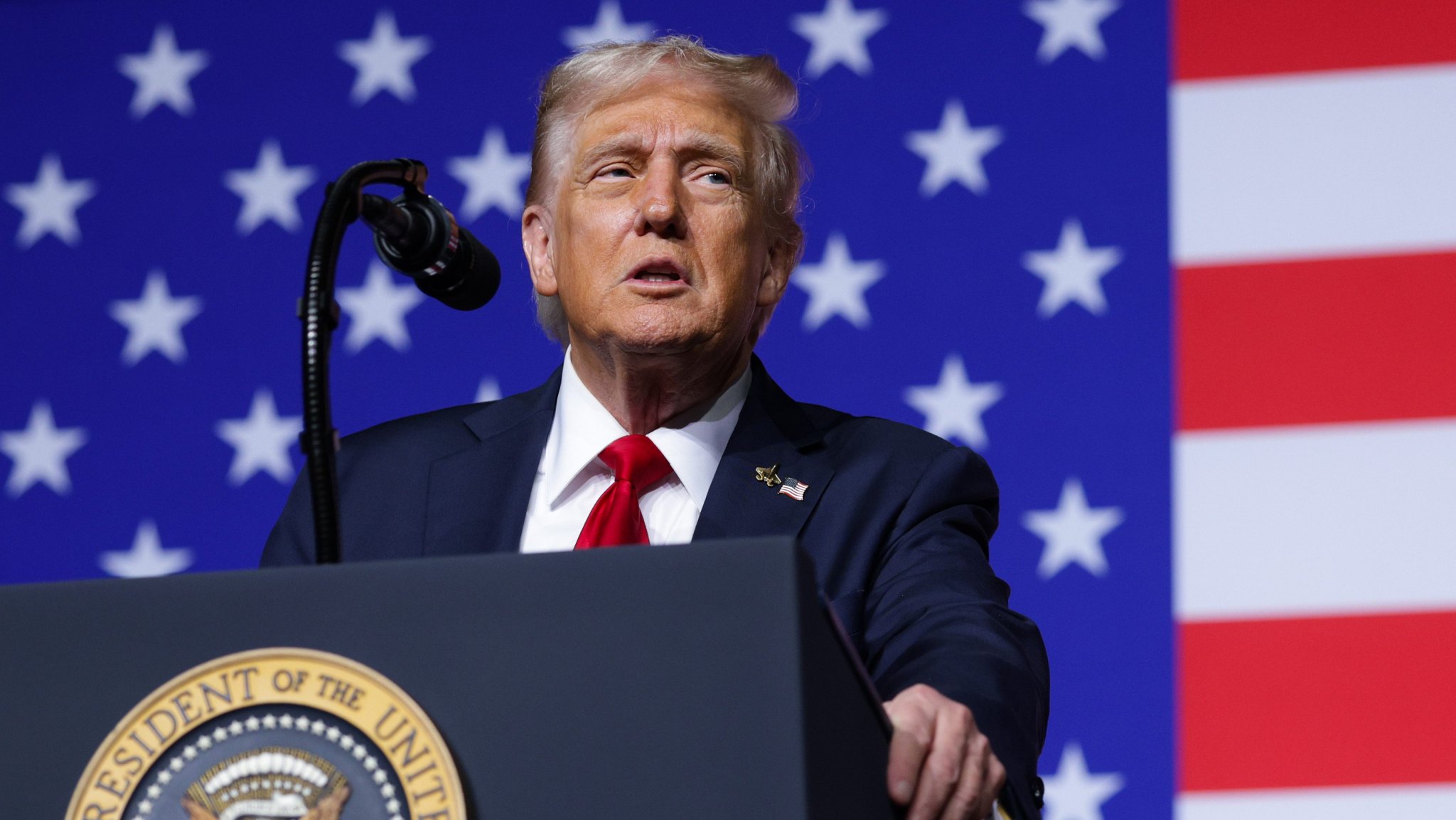
In front of an audience of top brass on Tuesday, President Donald Trump suggested the military use American cities as “training grounds” and that senior leaders would be part of combating “a war from within.”
Trump named San Francisco, Chicago, New York and Los Angeles as cities run by “the radical left Democrats” and said that the military leaders in the room he was addressing would be involved in helping “straighten them out, one by one.”
“That’s a war too,” he said. “It’s a war from within.”
Secretary of Defense Pete Hegseth addressed the top brass before Trump, warning adversaries against “FAFO” and senior leaders that if they disagreed with the direction of the Pentagon under his leadership, they should resign, among other comments central to his efforts to root out “woke” culture in the military.
The address was the payoff to a week of speculation after Hegseth abruptly called hundreds of military leaders from theaters around the world to Quantico, Virginia, last week without giving a reason why. In speeches that lasted about two hours, the two leaders did not shy away from escalating the administration’s willingness to use military assets domestically – and specifically against Democratic-led cities.
“I told Pete [Hegseth] we should use some of these dangerous cities as training grounds for our military – National Guard, but military,” Trump said, adding that “we’re going into Chicago very soon” and describing Portland, Oregon as a “war zone.”
The comments also come as the military has become increasingly intertwined with federal law enforcement efforts and immigration crackdowns, with thousands of troops deployed to the U.S.-Mexico border, while other units repatriate migrants off U.S. soil or guard them at Naval Station Guantanamo Bay, Cuba.
Hegseth recently authorized the deployment of 200 National Guard troops to Portland, which resulted in an immediate lawsuit from the city as Memphis, Tennessee also prepares to receive troops to its streets as well.
Trump’s campaign-like address was met with a largely tepid response in the room full of top brass.
“I’ve never walked into a room so silent before,” Trump said at the beginning of his speech. “If you want to applaud, you applaud. And if you want to do anything you want, you can do anything you want. If you don’t like what I’m saying you can leave the room.”
“Of course, there goes your rank, there goes your future,” he added.
Top Stories This Week
Some experts said that the response from the general and admirals was an indication that the relationship between the military and its leaders – specifically the prohibition on brass participating in partisan speech – was still intact.
“It is within a president’s purview to make those comments to a political audience or to a political rally,” Katherine Kuzminski, the director of studies at the Center for a New American Security and an expert in civil-military relations, told Task & Purpose in an interview on Tuesday. “But it’s very different when we consider the norms of military professionalism to be making those statements in front of an audience of uniformed leaders, particularly our flag and general officers and their senior enlisted advisors.”
Those norms were recently challenged in June when Trump visited Fort Bragg, North Carolina to give what became a partisan political speech, including attacks against his perceived political enemies to cheers and jeers from the crowd of mostly young soldiers.
“Our uniform leaders are called not to be partisan, regardless of whether or not they agree or disagree,” she added, and their response to the speech “indicates that we can trust our uniform leadership to follow the laws, policies and regulations that they’re under, as well as the norms.”
