

Watch one of the Army's potential Black Hawk replacements take its first flight

Military Tech

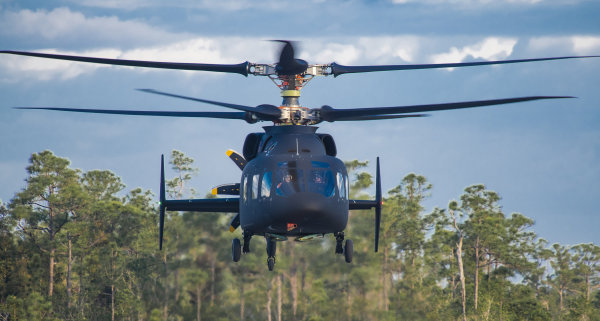
The SB-1 Defiant is finally here and ready to party.

After years of delays, Boeing and Sikorsky's unusual coaxial rotor helicopter conducted its first flight in the skies above Florida on Thursday, the companies announced.


"Today's flight was a tremendous success and a culmination of a lot of work by the men and women of the Sikorsky-Boeing team DEFIANT team," the joint team told Defense News ini a statement. "So much credit goes to their tireless efforts to get us to where we are today."

The Army is considering two advanced rotary-wing aircraft replace the UH-60 Black Hawk and AH-64 Apache helicopters in the U.S. Army's fleet. as part of the service's Future Vertical Lift program: the Defiant and Bell Helicopter's tilt-rotor V-280 Valor.

The SB-1 Defiant takes flight (Boeing/Sikorsky)
While the Valor enjoyed a slew of firsts in 2018 — conducting its maiden flight and achieving speeds of up to 190 knots in cruise mode — the Defiant's first flight was delayed for a year due to blade manufacturing issues, among other technical issues that threw the brakes on system testing.

"At the end of the day, this was never about how quickly we got to the first flight, but rather about providing the U.S. Army with the necessary, robust and relevant data that will enable them to make fully informed decisions as they pursue the Future Vertical Lift program and we're doing that," the Boeing-Sikorsky team told Defense News in a statement.

The Defiant is, as Task & Purpose previously described it, "a bigger, badder version" of Sikorsky's S-97 Raider, its coaxial rotor system "designed to fly at twice the speed and range of today's conventional helicopters and offers advanced agility and maneuverability," according to Lockheed.

The Pentagon's fiscal year 2020 budget request released earlier in March included roughly $790 million for Future Vertical Lift research and development, including $152 million for FVL advanced technology.

SEE ALSO: The Army's Black Hawk Replacement is One Step Closer To Dropping You Off At Fort Bragg

WATCH NEXT: Bell's V-280 Valor Rolls Deep In Cruise Mode
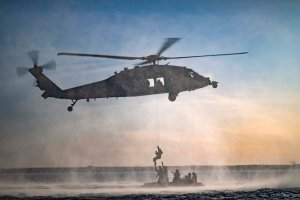
The ISIS caliphate is still not dead.

White House spokeswoman Sarah Sanders told reporters on Friday that the Pentagon "made the call" that ISIS had lost all of its former territory in Syria, according to a White House press pool report.

"When we asked if the caliphate was 100 percent eliminated, Sanders repeatedly said, 'Yes,'" the pool report says.

Read More Show Less
Photo courtesy of the Gary Sinise Foundation

Editor's Note: This article by James Barber originally appeared onMilitary.com, a leading source of news for the military and veteran community.

Gary Sinise just published a new memoir called Grateful American, and it's every bit as modest as anyone who has followed his years of support for the veteran community would expect.

Read More Show Less

Two U.S. troops were killed in Afghanistan on Friday, the NATO-led Resolute Support mission said.

The service members' names have not yet been released. Per Defense Department policy, the names of fallen troops are withheld until 24 hours after their next of kin have been notified.

Read More Show Less

MISHAWAKA — On a visit to the AM General Military Assembly plant in Mishawaka Thursday, Secretary of the Army Mark Esper highlighted his plan to modernize the Army and emphasized the important role he said AM General and its HMMWV (Humvee) will play in that modernization.

"The Humvee is a very capable light truck. It's very versatile, it allows us to perform a range of missions," Esper said. "Like we like to say, it's one of many tools in the tool kit."

Read More Show Less
Guided missile cruiser USS Lake Champlain (CG 57) steams in the Southern California operating area. Lake Champlain is operating with the USS John C. Stennis (CVN 74) Carrier Strike Group, conducting Composite Training Unit Exercise (COMPTUEX) in preparation for an upcoming deployment. (U.S. Navy/Photographer's Mate 2nd Class Jayme Pastoric)

The U.S. Navy is proposing soon to decommission six of its 22 Ticonderoga-class cruisers. The 1980s-vintage ships, the largest surface combatants in the U.S. fleet, increasingly are suffering structural problems requiring costly and time-consuming overhauls.

Read More Show Less