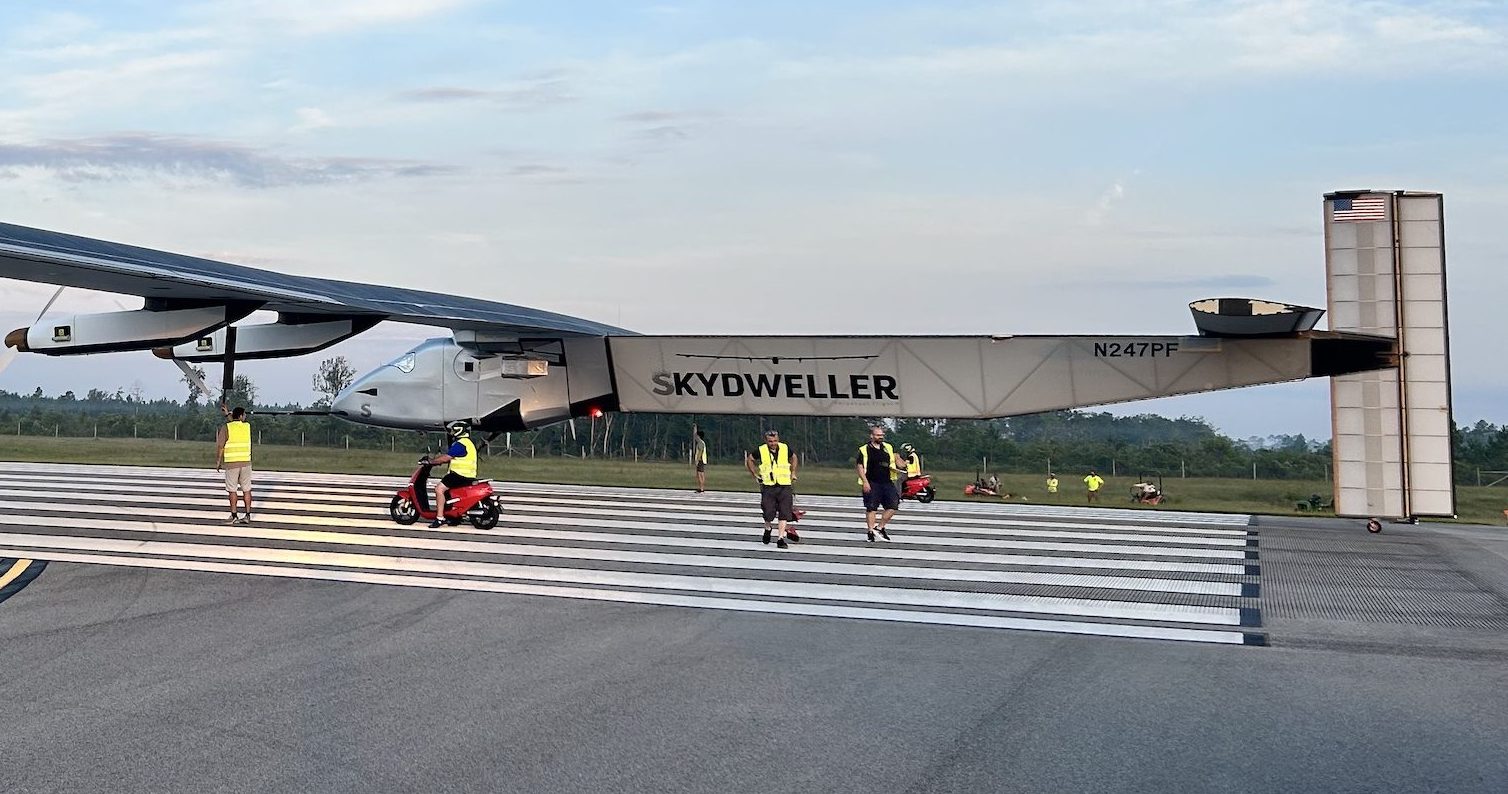
The Navy flew a solar-powered, unmanned drone for 73 hours straight, recharging the plane’s batteries during the daytime on solar power to fly through night hours without coming back to earth.
In total, officials with the Naval Air Warfare Center Aircraft Division flew the Skydweller drone off the Mississippi coast for nearly 220 hours, or over nine days, with breaks on the ground for inclement weather. The longest single flight was 73 hours, or about three days straight.
And engineers think the plane can fly longer.
“The constraints between the size of the range and the weather at this time of year in that region just didn’t cooperate to allow us to go further,” said Bill Macchione, he division’s manager for drone projects. “There’s no reason to believe we couldn’t have run that entire 220 hours, continuous.”
Made from carbon fiber, the Skydweller’s four electric propeller engines draw their power from solar energy. The drone’s wingspan is as wide as a Boeing 747 aircraft, but the plane weighs just 5,620 pounds or about the same as a Ford F150 pickup truck.
As it flies during the day, solar panels that cover nearly every inch of the plane power the engines and store excess energy in batteries. The batteries power the engines at night.
The Navy’s July test flight was prepped to get the drone “close to the solar cycle,” in order to prove that the solar-powered drone could generate and store enough electricity during the daytime to fly all night.
The test was not the first time Skydweller has logged multiple days aloft, but its previous long flights included a crew. The Swiss-made plane previously flew as the Solar Impulse, including a trip around the world in several legs in 2016 with two pilots on board. Flying three days with no pilot, though, puts it in the same league as other experimental all-solar aircraft designed solely for flight with no notable cargo capacity, like the Airbus-made Zephyr S. That plane, in testing overseen by the Army, flew 26 days in a 2022 flight.
Macchione said Skydweller should eventually be capable of that type of range and loitertime.
“It could have potentially stayed airborne much, much longer and that’s part of that test portion that we’re trying to get to,” Macchione said. “Next is bring it to an area where follow-on tests will look at flying it over a larger operational area and then test sensors on surrogate ships and track them during a multi-day operation.”
The Navy office has been experimenting with the Skydweller as part of larger Department of Defense interests to find platforms that extend the length of continuous intelligence, surveillance and reconnaissance missions. The Skydweller, Macchione said, can “just sit overhead an area and basically stare, kind of in what folks call a ‘pseudo satellite role.’”
While the Pentagon increases its use of satellite technologies and continues to use long range unmanned aircraft like MQ-9A Reaper drone and the Air Force RQ-4 Global Hawk aircraft for intelligence-gathering operations, expensive systems which Macchione equated to “buying an expensive race car to go to work every day.”
Skydweller is cheaper to buy and can be flown for missions dictated by combatant commanders.
“These types of platforms could potentially offer more of the local commanders a little more direct control over things that could be persistent and obviously, compared to a space program, an air vehicle is significantly less expensive, just fundamentally,” Macchione said.
With no onboard defensive measures, the Skydweller isn’t intended to replace those other technologies but rather give the local commanders a cheaper and more-direct option to do surveillance and reconnaissance.
“We can focus those precious assets on priority missions,” Macchione said. “In this case, this asset could be performing that constant surveillance, and [a commander] can direct those rapid response, highly capable assets he has under his command to address and prosecute targets of interest that are identified or that are maintained by this platform.”
Before the most recent flight, Macchione ran previous tests for 16 and 22.5-hour flights under a technology development agreement that Skydweller Aero Inc. signed with the Office of the Undersecretary of Defense for Research & Engineering. In 2020, the Naval Air Warfare Center began testing Skydweller “to address U.S. Southern Command operational challenges, including drug trafficking and border security,” according to a Navy release.
A SOUTHCOM official said the tests showed “a potential for mission benefit with lower operating cost if long-dwell autonomous platforms can be more operational deep in our [area of responsibility].”
The test flights were part of a Congressionally approved research project called COLDSTAR to develop surveillance and reconnaissance capabilities like autonomous aircraft, like the Skydweller, and high-altitude balloons that “can remain on station for weeks to months,” according to a release from Skydweller Aero Inc.
Renewables
Skydweller may solve the problem of constant battery swaps or recharging that has plagued other systems based on electric power, as the Army found in a recent exercise with battery-powered drones.
Transporting thousands of batteries to power non-solar drones poses a logistical nightmare, Dr. Mike Kweon, an Army lab program manager focused on power and propulsion research, said in a 2020 release.
“Without solving how to handle the energy demand, all other advanced technologies using artificial intelligence and machine learning will be useless for the Army,” Kweon said. “On the battlefield, we do not have the luxury to replace batteries for hundreds of [unmanned aerial vehicles] and recharge them for hours.”
Top Stories This Week
The limitations of powering new emerging technologies that rely on batteries instead of fuel is something that services are thinking about in a future conflict where military leaders anticipate a host of logistics challenges. The 2022 National Defense Strategy stated the Pentagon needed to make “reducing energy demand a priority and seek to adopt more efficient and clean-energy technologies that reduce logistics requirements in contested or austere environments.” Since then, the services have looked at a variety of renewable energy options to provide power sources in a contested environment, like mobile microgrids and electric vehicles.
At the same time, solar-powered drones are limited by adverse weather conditions and their power output, compared to jet-fuel-powered platforms that can move more rapidly, Macchione said.
The new systems will require soldiers skilled in getting the most out of battery life.
“Folks operating it at the ground control station are really focusing on energy management. That’s a whole other discipline, I should say that has to be managed on solar platforms. It’s their version of fuel quantity,” he said. “If you’re looking at a regular aircraft and you’re like, ‘how much fuel do we have?’ This is the equivalent of that.”