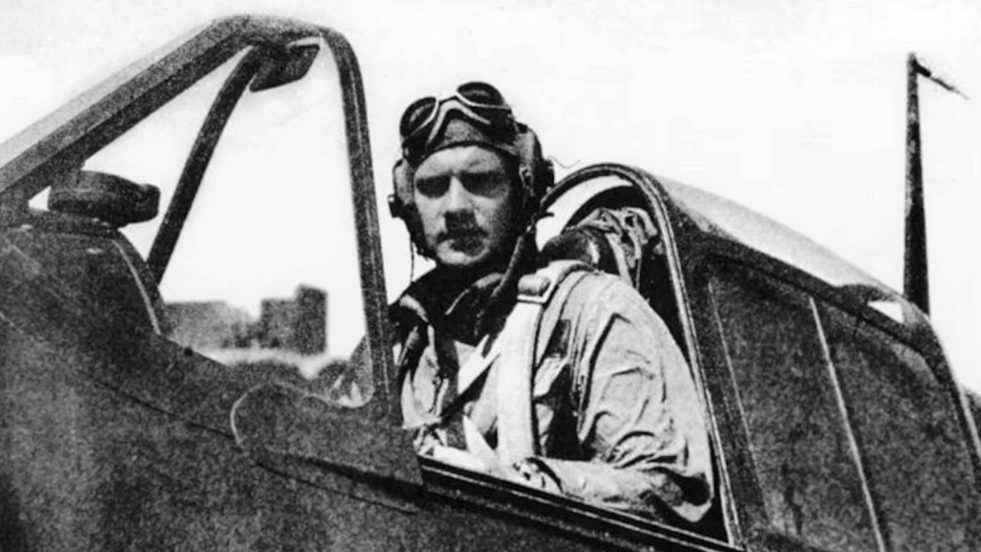
Donald McPherson, who scored five aerial victories and was considered the last living American ace pilot from World War II, died this month at the age of 103.
McPherson served as a naval aviator during the war, flying a Grumman F6F Hellcat fighter over the Pacific theater. He died on Aug. 14, according to his family. A funeral for McPherson took place on Aug. 19 at his home town of Adams, Nebraska.
Eight decades ago, in the skies above the Pacific, Ensign McPherson was part of Flying Squadron 83 (VF-83). Over the course of just over a month, he scored five aerial kills, earning him “ace” status. According to the Fagens Fighters World War II Museum and the American Fighter Aces Association, he was the last living American ace pilot from the war.
Born on May 25, 1922, he enlisted in the U.S. Navy in January 1943, taking advantage of the service waiving its two-year college requirement for people hoping to be aviators. He earned his wings and was commissioned in August 1944, marrying Thelma Johnston only a few days later. He then shipped out to the Pacific theater with VF-83, assigned to the USS Essex. It was the latter months of the war, but fierce fighting continued, and McPherson soon saw combat.
Flying a F6F Hellcat named “Death ‘n Destruction,” McPherson took part in a large pre-dawn raid on a Japanese airfield on Kyushu in March 1945. The Navy planes flew 300 miles to the airfield and then opened fire on bombers on the ground. McPherson took out a Mitsubishi G4M as it sat on the airfield then pulled up. His Hellcat stalled and as he worked to get the engine going again, Japanese anti-aircraft fire struck his plane. He got away, but after the fight, crews found that a 20mm cannon round had pierce the fuselage only a foot behind where he sat, he later recalled.
A month later he got his first two aerial kills. The USS Essex and its fighters were pulled into the bloody Battle of Okinawa. While supporting the ground operations, McPherson spotted two Japanese fighters flying low over the ocean. He dived down, shooting one down. As he told the Fagens Fighter World War II Museum, he went to full throttle, moving to then take out the second shortly after. His squadron racked up 69 kills in one day, he told the museum, a new record.
He gained ace status a month later in May. On May 5, he spotted three Kawanishi E7k float biplanes, which were flying towards American forces on kamikaze attack runs. He flew his Hellcat to intercept them, taking out all three.
McPherson continued to fly as the war continued. He is credited with five aerial victories and was awarded three Distinguished Flying Crosses for his actions.
Top Stories This Week
He returned to Nebraska after the war, working as a mail carrier. “Donald’s life was a harmonious blend of hard work and passion,” his obituary noted. According to his family, McPherson did not talk about his wartime experiences. Instead, he remained in his community in Nebraska, working with veterans organizations and local groups, including coaching youth sports. He also took up woodworking and fishing as hobbies when not helping others.
“He was up to his eyeballs in service in all sorts of ways once he got back,” his son Dean McPherson told the Beatrice Daily Sun. “I mean, mail carrier, VFW, American Legion, Scouting, anything in the church or the community, he was right there in the middle of it.”
However, more accolades and attention to his military career came near the end of his life The ace pilot was awarded the Congressional Gold Medal in 2015.
Donald McPherson is survived by a son, two daughters and “many grandchildren and great grandchildren,” his obituary notes.