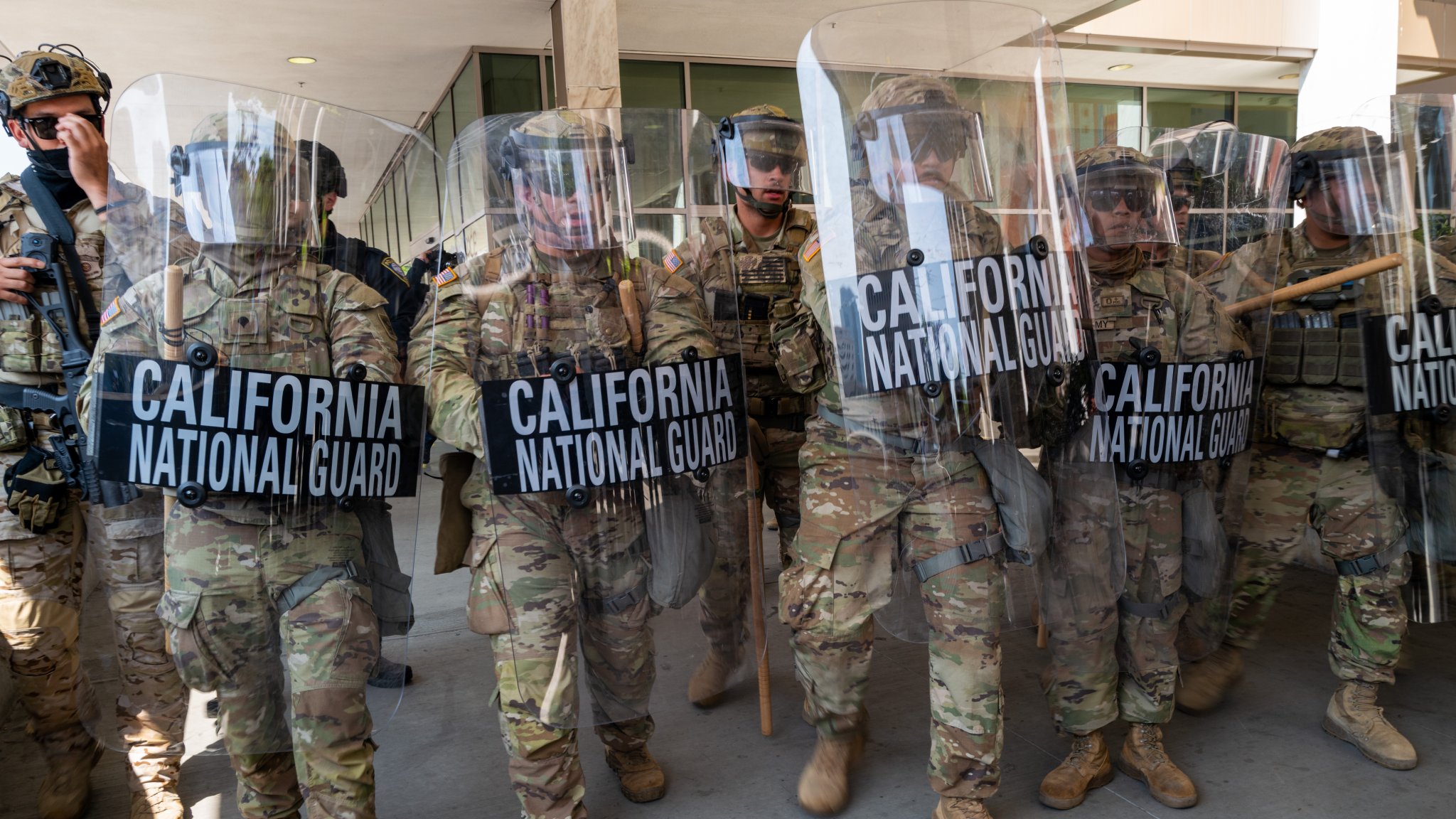
In June, 4,100 California National Guardsmen were put under federal control and deployed to Los Angeles. Two months later, and after most have withdrawn from the city and been released back to the state’s command, a court will now decide if that was even legal.
The trial over the use of the California National Guard started Monday in a district court in San Francisco. California Attorney General Rob Bonta is seeking the return of state authority over the federalized troops from the California National Guard, arguing that President Donald Trump violated the 19th-century Posse Comitatus Act that bars the military from conducting law enforcement in the United States.
Judge Charles Breyer, who is presiding over the trial, had previously ordered Trump to return control of the National Guard to the state of California in June. However, the Ninth Circuit Court of Appeals panel blocked that order while it handles an appeal over the president’s authority.
The three-day non-jury trial will revolve around what exactly federal troops can do stateside. Under the Posse Comitatus Act of 1878, the military (including the National Guard) is prohibited from conducting law enforcement activities. California is arguing that by accompanying Immigration and Customs Enforcement agents and other Department of Homeland Security personnel on immigration raids, the military violated that law. The federal government, in turn, is arguing that the National Guardsmen did not take part in law enforcement, but were simply protecting federal personnel.
“The factual question which the court must address is whether the military was used to enforce domestic law, and if so, whether there continues to be a threat that it could be done again,” Breyer said at the opening of the trial, per Reuters.
The trial will see military and immigration officials testify. Maj. Gen. Scott Sherman, the commander of Task Force 51, which oversees the military mission to Los Angeles, was called to the stand on Monday.
The troops were federalized in June, after federal and local police clashed with protesters in Los Angeles County in the immediate aftermath of ICE raids in the area. Trump and Defense Secretary Pete Hegseth ordered troops from the California National Guard to be federalized under Title 10 of the U.S. Code and sent to protect federal personnel and property. The initial 2,000 were pulled from the 79th Infantry Brigade Combat Team, and another 2,100 were drawn from the 49th Military Police Brigade. Hundreds of Marines based out of Twentynine Palms, California, were also sent in to augment the federalized Guardsmen, organized under the command of Task Force 51.
The federalization and deployment of the National Guard was met with criticism from Los Angeles elected officials, California Gov. Gavin Newsom, and the Los Angeles Police Department, which argued it could handle the protests in Los Angeles without the military’s involvement.
“The federal government deployed military troops to the streets of Los Angeles for the purposes of political theater and public intimidation,” Bonta said in a statement on Sunday ahead of the trial.
Top Stories This Week
Once deployed, the majority of National Guard troops were positioned at federal buildings around Los Angeles County, standing guard but not directly engaging with protesters. However, some accompanied ICE and DHS personnel on immigration raids, including operations in agricultural areas north of Los Angeles and in a drug bust more than 100 miles east of the city.
U.S. Northern Command told Task & Purpose in June that Task Force 51 was “not constrained by the geography of Southern California.” The one instance of servicemembers detaining a civilian involved the Marines, and the person, an Army veteran who walked onto a federal campus, was quickly released.
Task Force 51 started releasing troops at the start of July, rotating out one Marine unit with another and releasing some Guardsmen to deal with wildfires in California. Additional drawdowns continued over the following weeks, including the withdrawal of all the Marines deployed to Los Angeles. At a briefing last week, a Pentagon spokesperson said that approximately 300 National Guard troops remain under federal control in Los Angeles.
The trial started the same day that Trump announced he would send 800 District of Columbia National Guard troops into Washington, D.C. Unlike with the California National Guard, Trump cited Title 32 of the U.S. Code, or “federal-state status,” which means they are not subject to Posse Comitatus, to address what he called a crime emergency. Trump similarly called up the National Guard under Title 32 in 2020. Trump has also raised the possibility of redeploying the National Guard to Los Angeles in the future. Last week, Trump announced the creation of a White House task force for the 2028 Olympic Games, set to be held in Los Angeles. While announcing the new task force, Trump said that “We’ll do anything necessary to keep the Olympics safe, including using our National Guard or military, OK?”