More than 100 sailors were sleeping a few dozen yards from the point of impact where a merchant vessel slammed into the steel sides of the aircraft carrier USS Harry S. Truman on Feb. 12. Another group of eight sailors was on duty in a compartment just 10 feet from the impact, according to a Navy investigation released on Thursday.
Both groups survived unscathed, narrowly avoiding disaster.
“A small change in the timing of the collision or the angle of the impact could have caused catastrophic results,” Rear Adm. Todd E. Whalen, commander of Carrier Strike Group 3, wrote in his endorsement of the investigation. “Had the collision occurred 100 ft forward, the impact would have likely pierced a berthing compartment with 120 sleeping sailors.”
Whalen added that eight sailors were in a space that was less than 10 feet from where the two vessels collided.
Top Stories This Week
“A 1-degree change in trajectory could have destroyed the space and caused eight fatalities,” Whalen wrote. “My team spoke with those eight sailors, and they will never forget how close they came to losing their lives. Neither should we.”
Capt. Dave Snowden was fired as the Truman’s commanding officer shortly after the collision, which took place near Port Said, Egypt.
The investigation likened the incident to the 2017 collision between the destroyer USS Fitzgerald and a container ship, in that both were “caused by Bridge teams’ and supporting watchstanders’ poor decisions and failures in Bridge Resource Management (BRM).”
At 10:55 p.m. that evening, the captain left the bridge and went to his cabin, planning to sleep until 3 a.m., the investigation found.
After he left, the Truman’s speed was recorded at 19 knots, faster than its planned speed of 10 knots, according to the investigation. There were several other vessels in the area at the time.
Later, the captain told the officer of the deck to notify him if any other vessels came within 1,000 yards of the Truman.
However, as the Truman passed other vessels, the officer did not consult with the captain or sailors in the combat information center, which normally provides information for navigation.
At 11:29, when the Truman had planned to be traveling at just 5 knots, it was still steaming at 19 knots.
At one point, the sailors standing watch on the bridge misjudged the direction that the merchant vessel Besiktas-M was turning. The officer of the deck tried to raise the Besiktas-M’s bridge but got no response.
The captain was called to the bridge, and the Truman sounded five blasts from its horn to signal danger.
By the time the captain arrived on the bridge, the Besiktas-M was only 500 yards away.
The officer of the deck ordered hard left rudder, but just 15 seconds later the captain gave the opposite order: Hard right rudder.
At 11:45 p.m., the two ships collided.
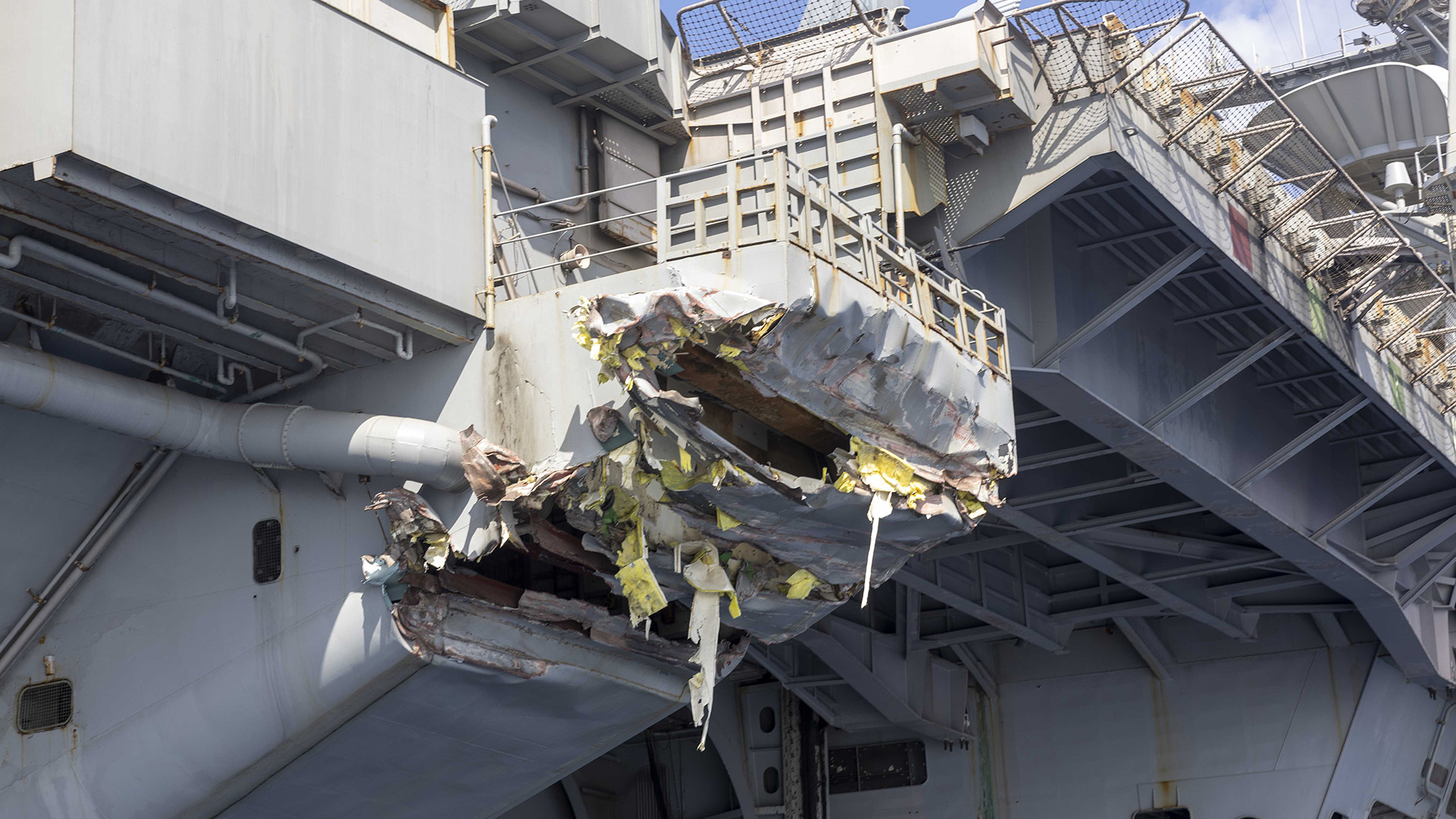
The initial impact created a gash along the Truman’s hull that investigators measured at 20 feet long and 7 feet wide.
But the exact point of impact, investigators determined, turned out to be a lucky break.
“Additional contact with the hull produced a 15-ft gash spanning portions of the aviation parachute equipment shop (which was manned by eight sailors), an unmanned tire storeroom, an unmanned line handling space, a void, and the fantail,” the investigation says.
But the collision did not cause any fires, flooding, electrical damage, or injuries among the crew. The mishap did not affect flight operations from the carrier.
The investigation’s recommendation included making changes to tests about navigational rules on avoiding collisions by replacing multiple choice with short answers; considering opening navigator billets to surface warfare officers instead of just aviators; and possibly developing a training module for how commanders and executive officers can manage fatigue to include “the use of wearable technology to help COs/XOs monitor their performances, sleep, and resilience similar to professional athletes.”
Additionally, the Navy released the findings of three other investigations on Thursday that looked into three mishaps Truman lost three F/A-18F Super Hornets during its deployment, including one that was accidentally shot down by the cruiser USS Gettysburg.
“The Navy’s sustained combat operations in the U.S. Central Command area of operations for the past two years demonstrated our battle effectiveness and ability to maintain freedom of navigation,” Vice Chief of Naval Operations Adm. Jim Kilby said in a statement