
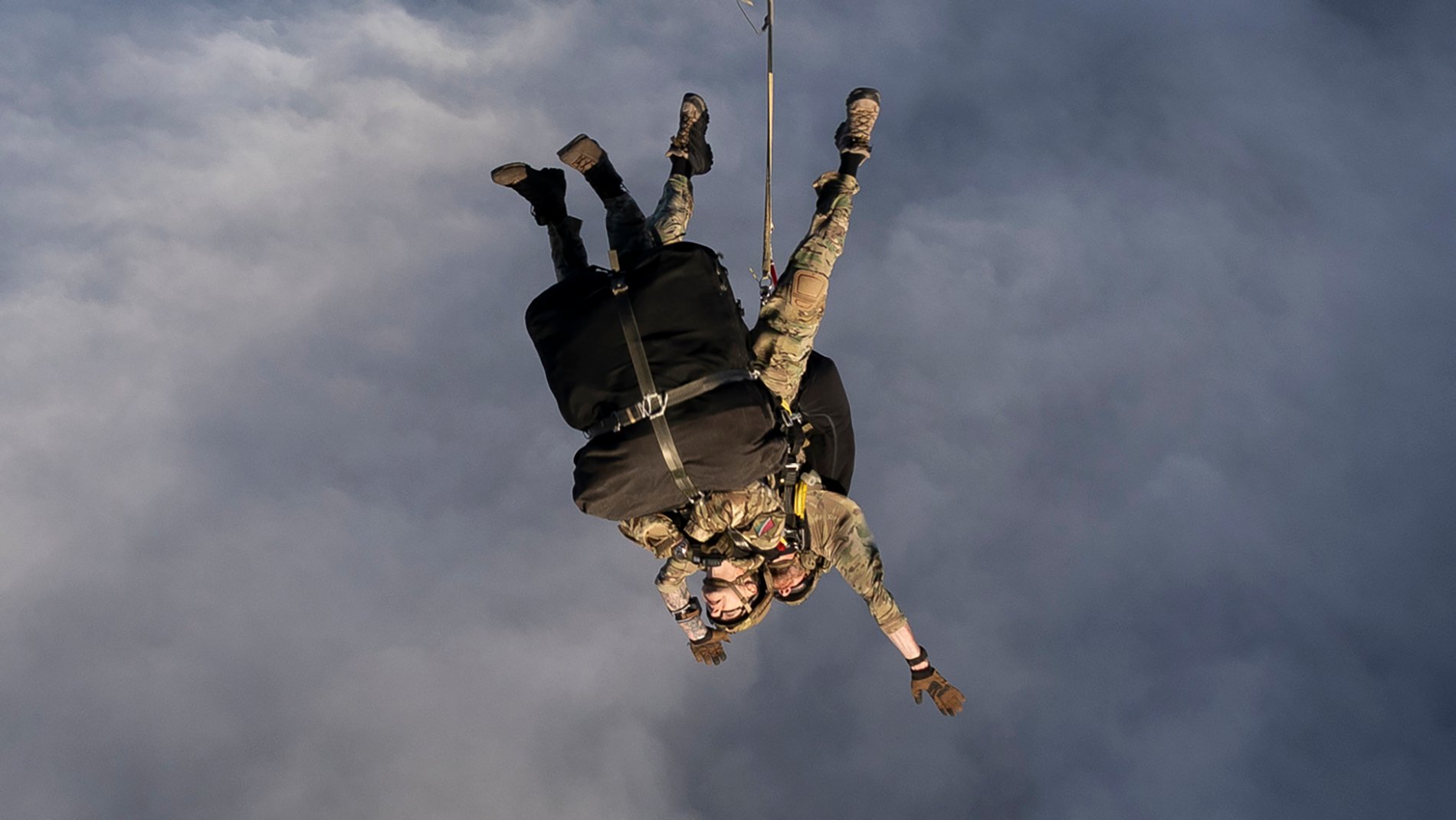
A mission to reach a sick man on a remote island in the southern Atlantic Ocean last month prompted a team of British soldiers to pull off one of the rarest, most high-risk parachute jumps that special operations troops have in their bag of tricks.
Flying 7,000 miles from a base in England, a team of six British commandos from a Pathfinder platoon in the 16 Air Assault Brigade jumped from a cargo plane over the island of Tristan da Cunha to reach a local man showing signs of Hauntavirus. Two of the Pathfinders carried a pair of medical specialists as passengers on the jump, one a doctor, the other a critical care nurse. Each of the two soldiers jumped from the A400M transport with one of the medics attached to them in specially-made 2-person harnesses, along with an oversized bag of their equipment.
The two-person jump technique, known as a tandem, was adopted by U.S. special operations forces in the 1990s, following a boom among two-person jumps in civilian skydiving. Even today, qualifying as a tandem master remains one of the rarest skills — and is used on some of the most secret missions — among elite troops around the world.
From civilian ‘thrill rides’ to secret missions
Tandem jumps were invented by civilian skydiving legend Ted Booth in the early 1990s. A former coach of the West Point parachute club, Booth was a pioneer in civilian skydiving for almost five decades. But in the 1980s, he realized that the hours of ground instruction needed to get a civilian ready for their first jump with a parachute by themselves were holding back business.
To make a first skydive no more difficult than an amusement park ride, he built a double-person harness with an oversized parachute. With it, a novice could be strapped onto the chest of an expert jumper, who would fly them both to the ground.
Military jumpers took the idea and, of course, made it much, much more miserable.
By the 1990s, Army special ops soldiers, Air Force Pararescuemen, Marine recon teams and Navy SEALs had developed jumping rigs not just for people, but for cargo-carrying barrels that hang beneath a jumper as they fall.
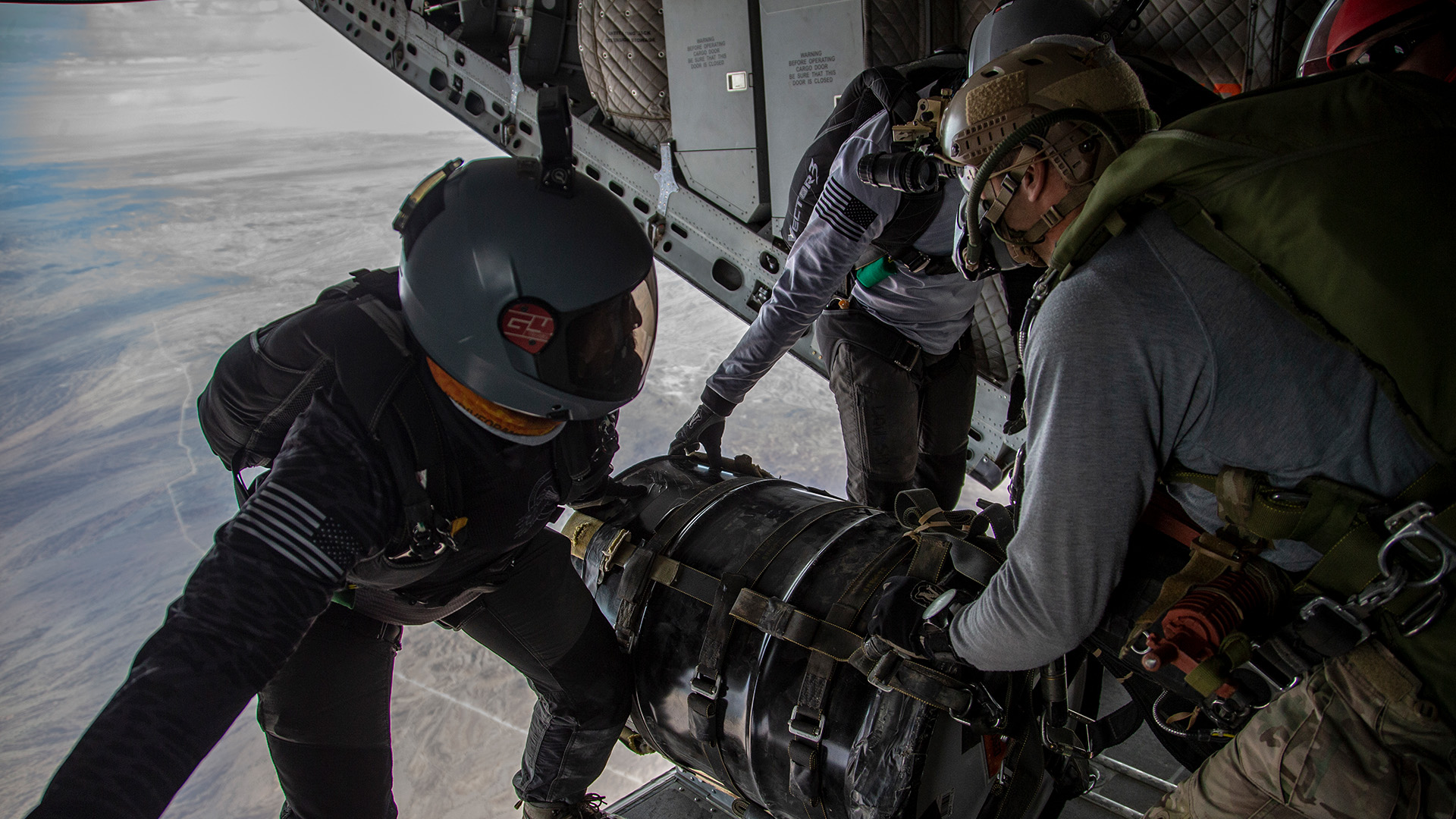
Even among the most elite troops, “jumping the barrel” is widely known as a brutal task. Jumpers leave the back of a cargo plane in freefall, but with the often-several hundred-pound barrel attached to their tandem harness. As it falls away, its full weight jerks the jumper once during freefall, then again when their oversized parachute opens above.
Across all U.S. military services, most special operations units now have at least a few members qualifed as tandem masters, but it remains a rare skill. The qualification is usually offered to senior troops who already have dozens or even hundreds of freefall jumps. Those wanting to qualify must pass a three-week tandem master course at the Army’s Military Freefall School at Yuma Proving Ground, Arizona.
Few ever do. Tandem masters were only fully integrated into Special Forces groups in the last decade, while a 2012 Air Force fact sheet noted that, though every pararescueman in the Air Force qualifies in freefall parachuting during their initial training, only about 1 in 12 ever move up to tandem status.
Top Stories This Week
Like the British mission, U.S. teams have parachuted doctors to reach critical patients in the past, and special operations teams used tandem jumps in Afghanistan to set up runways and other follow-on missions in remote spots.
In a combat mission, among a team of 8 to 12 operators, 1 or 2 might jump a barrel or other oversized equipment, including team-wide gear like radios, weapons, and ammunition, while the remainder of the team jumped with their own, single-person cargo loads.
That was roughly the make-up of the British team that jumped to Tristan da Cunha in May, with two tandem masters and passengers, and four other pathfinders. The territory is Britain’s most remote inhabited overseas territory, on a string of islands in the southern Atlantic Ocean. The single town has a population of about 200 people, no airstrip, and is reachable only by a week-long boat crossing from South Africa.
Loading comments…
Comments couldn’t be loaded. Please refresh the page.