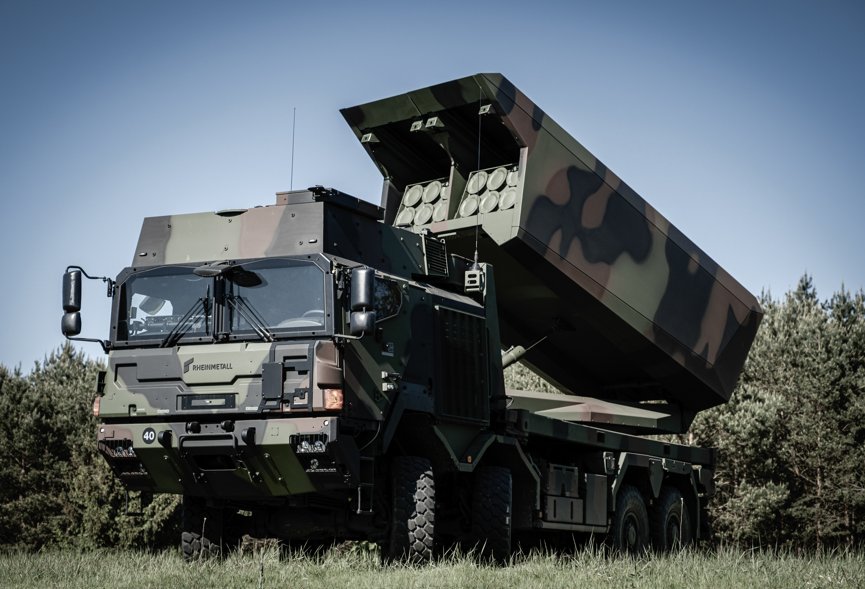
Artillery has long been called the “King of Battle” due to its ability to impact a battlefield, and it isn’t going to give up the crown to upstarts like small drones just yet. Systems like the High Mobility Artillery Rocket System (HIMARS) and the M270 have proven invaluable in conflicts from the Global War on Terror to Russia’s invasion of Ukraine. Now, Lockheed Martin and Rheinmetall have produced and test-fired the Global Mobile Artillery Rocket System (GMARS).
GMARS offers double the firepower of the High-mobility Artillery Rocket System, or HIMARS, matching that of the tracked M270, but in a wheeled version like HIMARS. It presents an interesting option to NATO nations and other militaries who may not want to wait years for HIMARS to be built, and prefer a system manufactured closer to home.
What is GMARS?
GMARS is a joint project between U.S.-based Lockheed Martin and Germany’s Rheinmetall. It’s built on the Rheinmetall HX 8×8 truck. With double the firepower of HIMARS, it can launch:
- 12 Guided Multiple Launch Rocket System (GMLRS) rockets with ranges from 70–150 kilometers.
- 2 Army Tactical Missile Systems (ATACMS) with ranges up to 300 kilometers
- 4 Precision Strike Missiles (PrSMs) with ranges of 500 kilometers and beyond.
This much firepower and range give GMARS precise and highly mobile long-range fires, which have proved essential for survival on today’s drone-laden battlefields.
How it compares
The HX 8×8 truck gives GMARS a range of about 600 kilometers on the road, with a high ground clearance and a central tire inflation system for rough or soft terrain.
That makes it more flexible for road marches and resupply than the FMTV 6×6 truck used by HIMARS or the tracked Bradley chassis used by the M270, which both have an operational range of about 480 kilometers.
Top Stories This Week
Otherwise, GMARS is designed to slot into existing NATO logistics and training pipelines. It fires the same munitions, uses the same fire controls, and can work alongside HIMARS or M270 batteries seamlessly.
Against competitors, GMARS is also ahead. Russia’s Tornado tops out around 200 kilometers. China’s PHL-16 can fire different calibers with ranges up to 360 kilometers. Iran’s Fadjr-5 reaches about 200 kilometers.
Why now
The rise of drones has changed how artillery fights. Cheap quadcopters and larger, more persistent intelligence, surveillance, and reconnaissance (ISR) platforms are spotting targets deeper behind enemy lines than ever before. Hitting those targets can be a challenge, though.
Fiber-optic FPV drones can only reach about 50 kilometers. Drones like Shaheds are slow and relatively easy to shoot down. Air strikes face contested skies and can take dozens of minutes to reach the target. A rocket launcher like GMARS, which just needs coordinates, can strike several hundred kilometers away, within minutes, and then displace to avoid counterbattery fire.
That “spot fast, shoot fast, move immediately” cycle is at the heart of modern artillery, and GMARS doubles the firepower available in that window.
Who’s buying it
Currently, there are no orders for GMARS, though both Lockheed and Rheinmetall have said the system is currently available for purchase.
The Pentagon isn’t a likely customer. The U.S. military already has HIMARS, M270s, and multiple modernization programs underway. But even if the U.S. never fields it, American units will likely train and deploy alongside allies that do.
Though nothing has been confirmed, Poland is one of the more likely customers. Sharing a border with Belarus, the country is currently ramping up defense spending with an especially keen eye toward multiple launch rocket systems, or MLRS. Recently, Warsaw signed a deal with Lockheed to purchase 486 HIMARS launchers to incorporate into their Homars-A program and also agreed to purchase 126 K-239 Chunmoo systems manufactured by South Korea’s Hanwha Aerospace for their Homar-K program. In both cases, Poland’s WB Group is fitting the launchers onto domestically produced trucks, specifically the Jelcz 6×6 for the HIMARS launchers and the Jelcz 8×8 for the Chunmoo. They’ve already illustrated a willingness to purchase what works now, and their approach of fitting the purchased launchers onto domestic trucks lends itself well to GMARS.
Smaller European countries that don’t have the defense industrial base of Poland, like Estonia, Lithuania, or Latvia, are potential customers for the entire GMARS, truck included. All three are NATO allies, and all have purchased HIMARS. They may find GMARS a compelling alternative thanks to its HX platform and compatibility with existing HIMARS and M270 across the rest of the NATO alliance.
The bottom line
GMARS takes everything HIMARS proved on battlefields from Iraq to Ukraine and doubles it. With twice the rockets in a single launcher, longer driving range, and compatibility with the newest long-range missiles, it gives NATO armies a powerful new tool. More than that, it reflects where modern artillery is heading: longer-range, highly mobile systems designed to survive in drone-saturated battlefields while striking targets hundreds of kilometers away. We discuss all this and more in depth in the latest for YouTube, which you can watch here.