Soldiers on the U.S.-Mexico border are using high-tech equipment ranging from drone-warfare systems to futuristic headsets to spot migrants and summon border patrol agents.
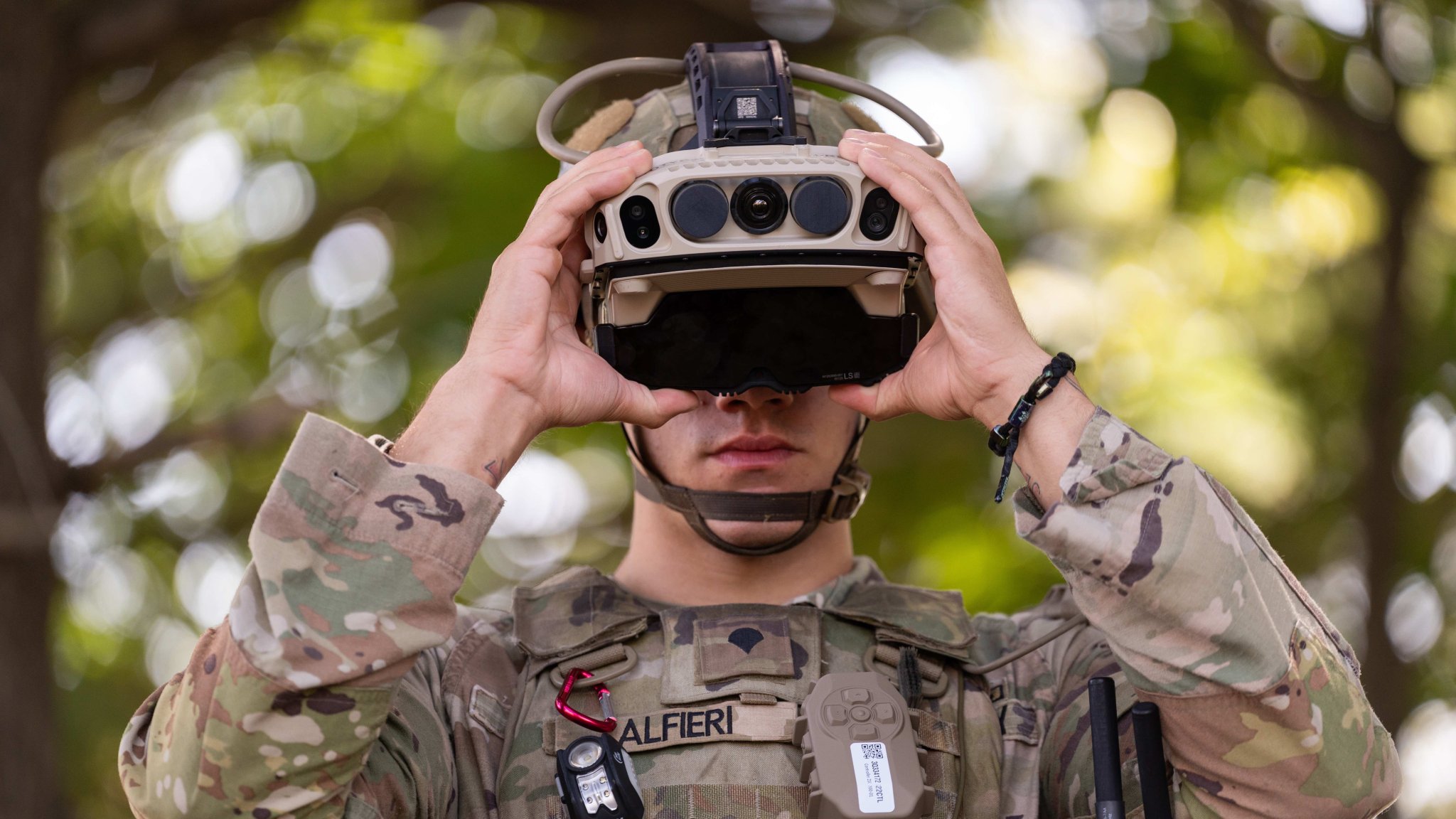
Among the high-tech gear the Army is putting through paces in its border mission are drones and drone jammers, advanced sensors and a gaming-style headset known as the Integrated Visual Augmentation System, or IVAS. The IVAS, which was developed by Microsoft beginning in 2018, received mixed reviews from soldiers in previous field tests.
The IVAS headsets include a heads-up see-through display with thermal and low-light imaging sensors, a compass for navigation and augmented reality features.
“You can place graphics on a map and that map is interactive as soldiers cross phase lines, checkpoints, etc.,” said Capt. Zander Wiesehuegel, a company commander for the 2nd Stryker Brigade Combat Team, which has soldiers in multiple states along the border. “Specifically for this mission, what it allows them to do is take data that they receive over a radio, they’ll plot that on a map, and then everyone who’s wearing that sensor is able to see where that’s plotted on a map.”
The night vision devices give soldiers “enhanced” planning and communication capabilities, Wiesehuegel said, adding that soldiers “very quickly communicate” with U.S. Customs and Border Patrol agents “where they’ve seen whatever they have seen.”
The Microsoft-built IVAS has had a rocky development path. Goggle tests from 2023 indicated that IVAS made soldiers less lethal and caused them to hit and engage fewer targets in training. In 2022, Pentagon tests found that IVAS caused soldiers “mission-affecting physical impairments” like headaches, neck pain, nausea, and eye strain.
An official with the Joint Task Force-Southern Border said soldiers are using IVAS 1.2, as opposed to the IVAS 1.0, which updated the system’s weight distribution “to reduce how heavy the system feels” and has “capabilities that allow a soldier to modify their settings to counter any symptoms if present.”
Army Times reporting from October 2024 highlighted that changes to IVAS fixed early user problems with moisture in the device, dizziness and display glitches.
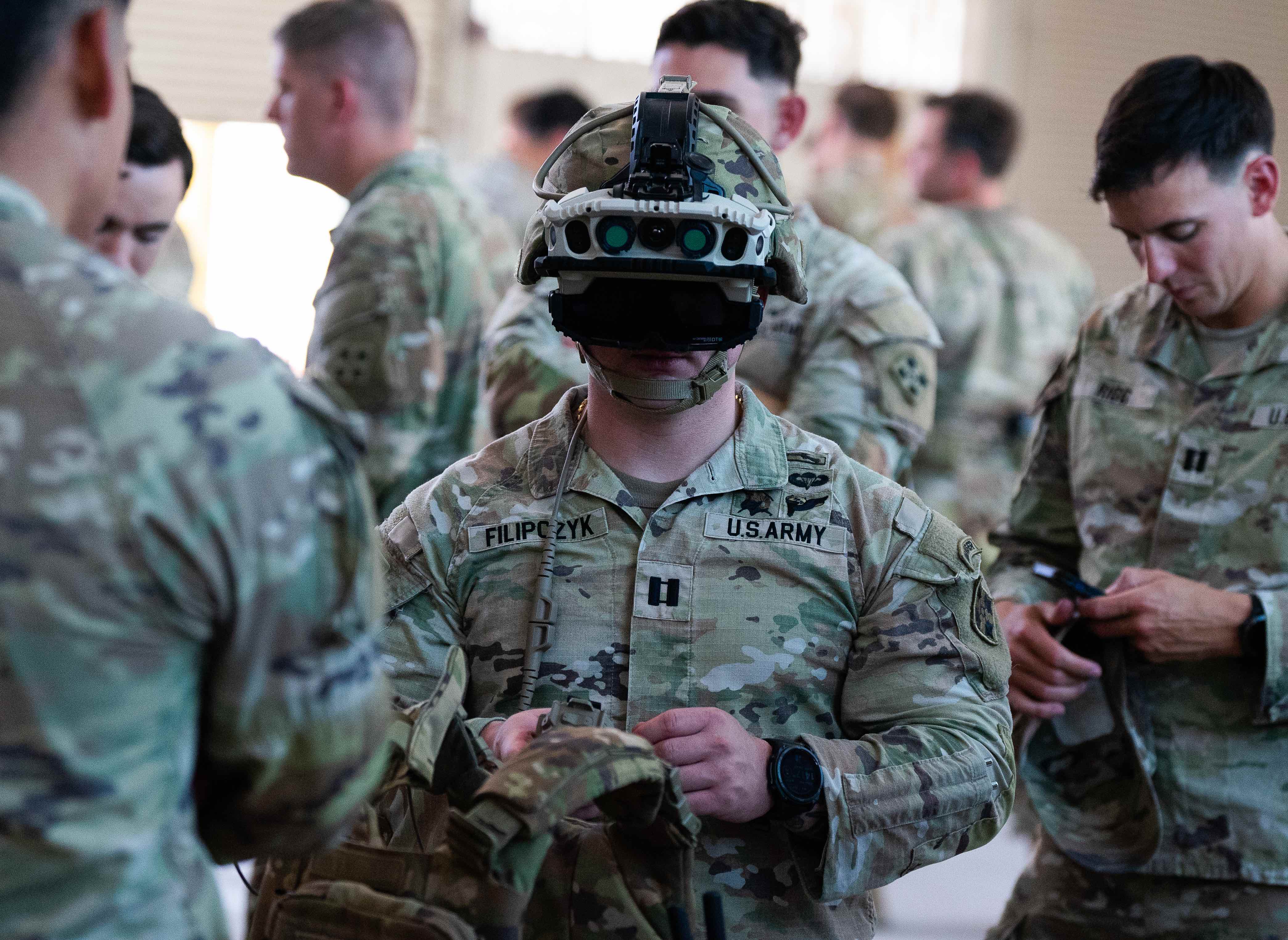
The project was originally managed by Microsoft and based on their commercially available Microsoft HoloLens device. In February, Anduril announced it would lead production, hardware and software development and delivery of the googles. Anduril has also enlisted the help of Meta on the artificial intelligence and augmented reality aspects of the headsets. The company touts IVAS as offering “beyond line-of-sight perception capabilities,” and “survivability against drones.”
An Army contract solicitation from April described the newly renamed Soldier Borne Mission Command Center project as a “digital awareness system” that provides day and night situational awareness for soldiers on foot.
Wiesehuegel said it took soldiers about three nights of border patrols to be comfortable using the night vision devices.
The border as a proving ground
The Army has made it clear it views the border mission as a chance to put unproven systems through real-world paces.
Maj. Geoffrey Carmichael, a spokesperson for the Joint Task Force Southern Border said that soldiers at the border “not only help to preserve the integrity of the United States southern border, but also create a laboratory of experimentation along the southern border.”
In March, the U.S. Northern Command announced that 2,400 soldiers from the Fort Carson, Colorado-based 2nd Stryker BCT would head south to carry out detection and monitoring operations. Officials insisted that soldiers “will not conduct or be involved in interdiction or deportation operations,” according to a NORTHCOM release announcing the deployment.
Soldiers from the 2nd Stryker Brigade Combat Team described using the new high-tech to find and detect migrants and report their position to law enforcement.
Wiesehuegel said that soldiers used the Afghanistan-era Common Remotely Operated Weapon Station, or CROWS system, to detect suspected migrants and used beyond line of sight radios to phone a nearby patrol squad, which summoned border patrol agents within “30 seconds to one minute.”
Top Stories This Week
The 2nd Stryker Brigade Combat Team soldiers are also using the Black Hornet 4, a microdrone developed in 2023, that weighs 70 grams and is used for innocuous surveillance. Soldiers are also carrying the Dronebuster to spoof and jam drone frequencies and redirect them. The TITAN system is designed to collect targeting information scan radio frequencies to detect nearby drones, said Capt. Ben Hale, one of the brigade’s company commanders.
“A lot of the systems that they’re using for counter [unmanned aerial systems], they didn’t have before coming to the border,” said Capt. Bailey Buhler, a spokesperson for the Joint Task Force-Southern Border. “The fielding of this equipment really has been timed with the receipt of this mission as the [Department of Defense] has seen an opportunity to support national security and to enhance our training in a place where there’s the ability to do it.”
Some of the Army’s longstanding combat equipment has been outfitted for more modern warfare threats like radar systems typically used for artillery and rocket defense that were updated to counter and respond to increased drone sightings at the border.
The CROWS system, used widely in Iraq and Afghanistan, has newer cameras, sensors and 360-degree situational awareness, according to the Army.
Multi-purpose companies
The soldiers are also part of new formations designed under the Army’s Transform in Contact initiative, an effort in which the service selects specific units to test concepts and technology that can eventually be incorporated across the force to fight future wars.
Two of the Stryker combat team units were designated as Multi-Purpose Companies. The MPCs retain their infantry and mortar platoons but add two more — one focused on electromagnetic warfare and another for chemical, biological, radiological, and nuclear reconnaissance.
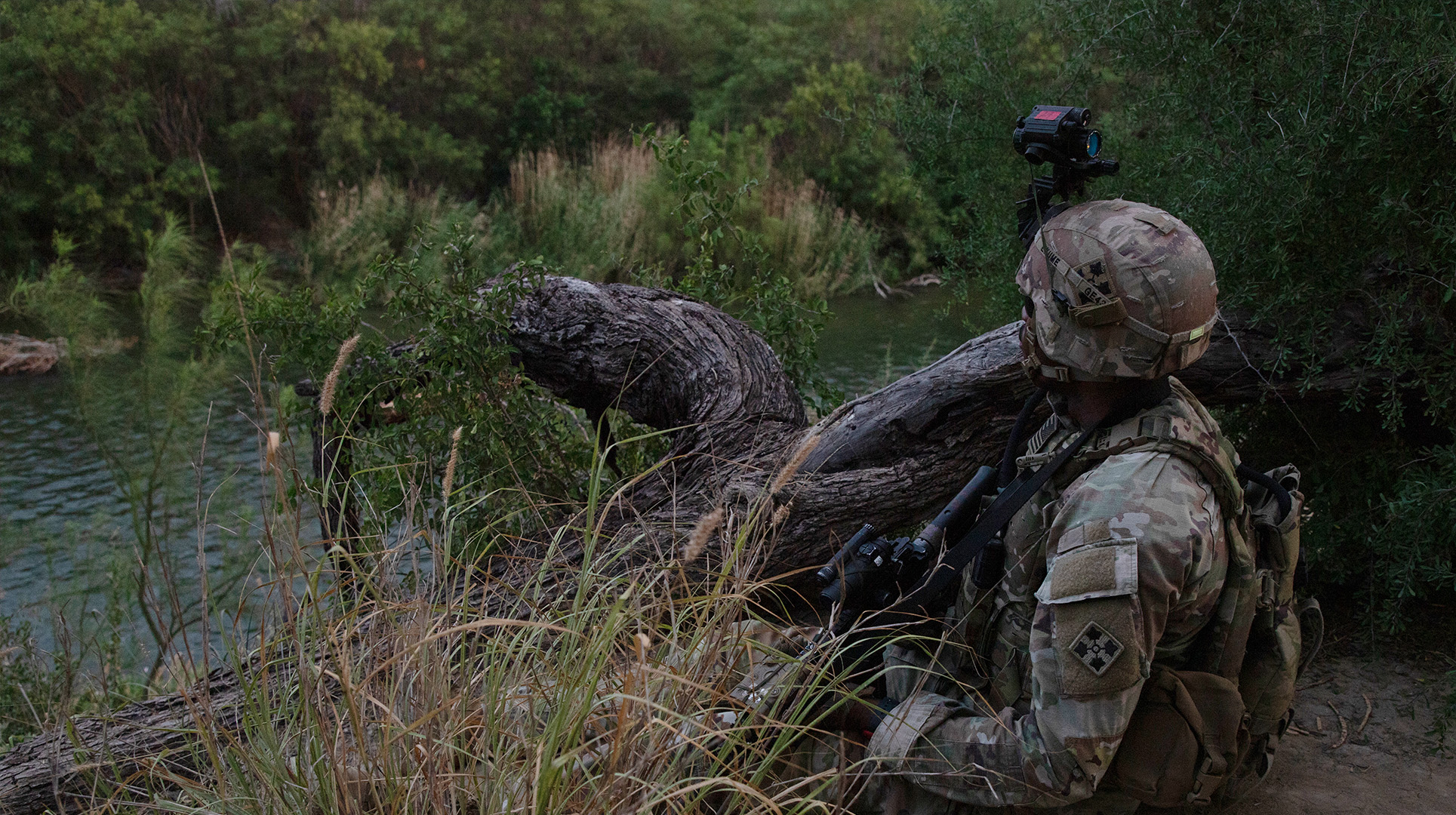
The 2nd Stryker Brigade Combat Team commander, Col. Hugh Jones, said in an Army release that their soldiers are responsible for having eyes on more than 1,044 miles-worth of the U.S.-Mexico border which means essentially having one soldier for every half a mile.
The MPCs can be used to send soldiers out in typical Stryker convoys that can cross mountainous terrain across multiple states or dismounted operations in swampy areas that are harder for vehicles to access and instead send soldiers out on foot, said Capt. Hale who leads one of the new MPCs.
“Across the border, you’ll see entirely different types of terrain,” Hale said. “As the joint task force identifies areas where we want more information or we can help Customs and Border Protection, they’re able to quickly flex the multi-purpose companies with all of these assets into that area regardless of any of the constraints that area might naturally have.”
The new formations have been tested at training centers but it’s the first time they’re being implemented for operations. At a Joint Readiness Training Center rotation in August 2024 at Fort Polk, Louisiana by the 101st Airborne Division’s 2nd Mobile Brigade Combat Team, one of the first units selected for the Transform in Contact effort. During the exercise, the MPC soldiers helped devise a deception plan using decoys that emitted Wi-Fi and Bluetooth signals to mislead enemy forces.